IBDS
Institute of Behavioural and Decision Science (行為與決策科學研究所)
Events
IBDS x IPUR Joint Research Webinars -
Shaping the Future of Risk Communication Research in Healthcare
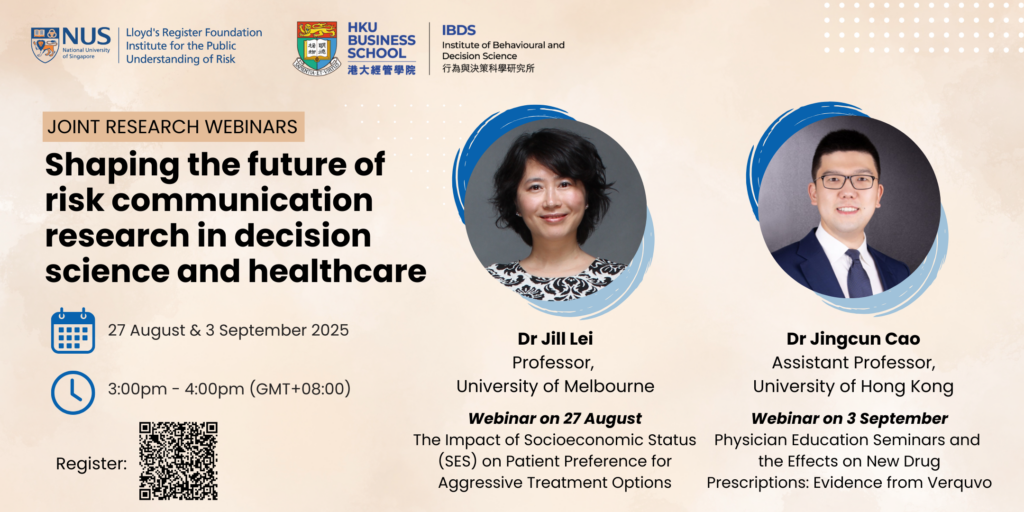
- 27 August 2025 (Wednesday) | 3 September 2025 (Wednesday)
- 3:00pm - 4:00pm
- Online
- Click HERE and register to receive the online webinar invite and details!
About this Event:
Shaping the Future of Risk Communication Research in Healthcare
In this two-part seminar series, jointly hosted by The University of Hong Kong’s Institute for Behavioural and Decision Science and the National University of Singapore’s Institute for the Public Understanding of Risk, two studies explored how psychological and social factors influence medical decisions.
The first session featured Prof Jill Lei (University of Melbourne), who presented research on how socioeconomic status (SES) shapes patient preferences. Her work revealed that lower SES individuals often prefer aggressive treatments due to a lower tolerance for uncertainty, while higher SES individuals may do so from a higher perceived value of their lives. The second session featured Prof Jingcun Cao (The University of Hong Kong), who examined the impact of Physician Education Seminars (PES) on drug adoption. His research found these knowledge-based digital marketing events significantly increased prescriptions both for attendees and their peers, demonstrating their effectiveness even under strict regulations.
Together, these seminars highlighted the profound role of behavioral science in understanding both patient and physician decision-making, offering insights for more effective and ethical healthcare communication.
27 August 2025 | Dr. Jing (Jill) Lei
The Impact of Socioeconomic Status (SES) on Patient Preference for Aggressive Treatment Options
For health conditions ranging from the common cold to cancer, patients often face a decision between conservative and aggressive options. For example, a person diagnosed with thyroid nodules might weigh watchful waiting against a minimally invasive thyroidectomy. In today’s patient-centred healthcare, patients play a growing role in treatment decision-making (Elwyn 2021; Epstein 2000). A key patient-related factor, socio-economic status (SES), is consistently linked to health outcomes (Adler et al. 1994), yet the behavioral mechanisms driving these outcomes are less understood. Our research explores how SES influences patient preference for aggressive vs. conservative treatments.
This seminar is the first session of a two-part series, “Shaping the Future of Risk Communication Research in Healthcare.” This session focused on Prof Lei’s research into the growing relevance of patient involvement in medical decisions and the need to understand the underlying factors influencing these choices, particularly as they pertain to health outcomes.
Prof Lei’s research emerged from both personal experiences and scholarly interest. From observing medical decision-making in her family to the hospital environment, she emphasized that patients are increasingly empowered. Surveys conducted showed that a substantial portion of patients feel confident in making health decisions. This shift in patient agency underscores the importance of investigating how patients evaluate treatment options, especially in scenarios that might lack information for either aggressive or conservative interventions. The research focused on real-world decisions, such as choosing between active surveillance and minimally invasive surgery for benign thyroid nodules, and extended to more acute conditions like myocardial infarction, where options range from less invasive procedures like PCI to major surgeries such as CABG.
The research had a central hypothesis, which was that SES significantly influences treatment preferences. The initial studies shared by Prof Lei, suggested that individuals with lower SES tend to favour aggressive treatments. This tendency was explained through the lens of psychological mechanisms: those with lower SES often experience greater environmental and financial uncertainty, leading to a lower tolerance for ambiguity and heightened risk perception. This, in turn, drives a preference for immediate and decisive treatments, which are perceived as both faster and more effective, albeit riskier and more costly at times. Conversely, even patients of a higher SES may value their lives differently, sometimes opting for aggressive treatments out of a sense of greater personal worth and the desire to maximize health outcomes, though for very different motivational reasons.
The research utilized both experimental and secondary data approaches. Online panel studies across various health conditions confirmed beliefs that invasive treatments are viewed as more effective and revealed that low SES individuals marginally prefer aggressive options. Secondary analysis of Australian healthcare data on heart attack patients confirmed these findings, showing that patients from lower SES backgrounds and those without private health insurance were more likely to receive more invasive CABG surgery. This runs true even when access and affordability factors were controlled by the public healthcare system. Interestingly, this effect was strongest when the health condition was less severe, suggesting that SES exerts more influence on medical decisions.
Further investigation uncovered an unexpected yet interesting finding of two parallel psychological pathways through which SES affects treatment choice. Lower SES individuals demonstrated greater intolerance of uncertainty, leading to higher risk perceptions and a preference for aggressive treatment. Higher SES individuals, on the other hand, may pursue aggressive treatment because they ascribe higher subjective value to their lives, which also heightens perceived risk. The interplay of these mechanisms sometimes cancels out the overall main effect, explaining the inconsistency in direct SES-treatment links observed across different studies. The seminar concluded with a discussion on practical implications such as targeted interventions, and to provide a holistic view of life, addressing the problem of unnecessary aggressive medical care.
In summary, Prof Lei’s research findings highlight the importance of psychological factors beyond mere economic constraints suggesting that SES acts as a cognitive switch activating different decision processes. This insight introduces patient-centered interventions, aiming for better health outcomes and more efficient use of medical resources.
3 September 2025 | Dr. Jingcun Cao
Physician Education Seminars and the Effects on New Drug Prescriptions: Evidence from Verquvo
With data from a leading online healthcare platform in China, we study the effects of physician education seminars, an important marketing activity that focuses on providing physicians medical knowledge without any in-person interactions with or monetary incentives from pharmaceutical firms, on physicians’ prescription choices of the new cardiac drug Verquvo. The causal effects are identified from the variation in the timing of seminars across geographical regions. The stringent regulatory environment in China also helps rule out confounders arising from other marketing activities. We find that participating in a seminar will increase a physician’s prescriptions of the drug by 28.8%, while reducing that of other drugs by 17.8%, suggesting these seminars are highly effective for drug promotion. The effects are not due entirely to the seminars’ informative function: the prestige of seminar speakers also plays a significant persuasive role. We also find a strong spillover effect, as participating in seminar will also increase the prescriptions of the physician’s colleagues in the same hospital. We use these results to predict the revenue and profit of running seminars to promote the drug.
This seminar was the second session of a two-part series, “Shaping the Future of Risk Communication Research in Healthcare.” This session focused on Prof. Cao’s research into the growing role of digital and knowledge-sharing-based marketing approaches in healthcare, especially in the context of increasing regulatory scrutiny of traditional drug promotion activities.
Prof. Cao began by outlining the challenges faced by pharmaceutical firms: the lengthy, costly, and often unsuccessful drug development process necessitates effective commercialization. In 2024, global healthcare marketing expenditure reached $42.28 billion, with nearly half directed toward physicians. However, in-person promotions—often involving incentives—have raised concerns regarding conflicts of interest and potential harm to patients. Consequently, many countries, including China, have strengthened regulations on inter-person or incentivized new drug promotion, driving the need for new, compliant communication channels to physicians.
The study examined Physician Education Seminars (PES), organized through a leading third-party online healthcare platform in China. These seminars are designed to enhance medical knowledge, similar to continuing medical education (CME) in US, but with strict rules: no direct pharma representation, no promotion of drug or company names, and no incentives for participants. The key research question was whether these educational interventions still influence prescription behavior of physicians and their peers.
The research focused on PES for vericiguat, a new heart-failure drug developed by Bayer. Using a stacked difference-in-differences (DiD) design, Prof. Cao’s team analyzed prescription data before and after 169 PES events conducted between August 2022 and January 2024. The results showed that physicians who attended a PES significantly increased their prescriptions of vericiguat by approximately 30% in the four months following the seminar.
The study further explored the underlying mechanisms. While PES serve an informative function, the results also suggest a persuasive role: talks given by high-status speakers or physicians from prestigious hospitals had a stronger impact on prescriptions, even after controlling for content similarity across seminars. This highlights the influence of authority and credibility in shaping physician behavior.
Additionally, strong peer effects were observed. Physicians who did not attend any PES but were in the same hospital department as those who did, also increased their prescriptions of vericiguat by about 29.5%, indicating that knowledge and influence spread through professional networks.
From a commercial perspective, each PES was estimated to generate an additional profit of approximately CNY 334,337 for the pharmaceutical firm over four months, nearly six times the profit without accounting for peer effects.
The seminar concluded with important policy implications: educational seminars can effectively promote new drugs even in a tightly regulated environment, even without direct monetary incentives. However, the persuasive element associated with speaker authority suggests that such channels are not purely informational. Regulators and firms must therefore balance educational value with transparency to ensure marketing practices align with patient interests.
In summary, Prof. Cao’s research demonstrates that knowledge-driven marketing through third-party PES significantly affects physician prescribing behavior—both directly and through peer influence—highlighting the need for continued scrutiny and ethical consideration in the design of digital medical education.
About the Speakers:
Dr. Jill Lei
Dr. Lei is a Professor of Marketing and Head of the Department of Management and Marketing at the University of Melbourne. Her primary research interest lies in consumer decision-making in contexts such as food, finance, and healthcare. She has taught in the Netherlands, Canada, China, and Australia, and has served as Associate Editor for the Journal of Consumer Psychology. She served as an Associate Editor for the Journal of Consumer Psychology and has published her work in marketing journals, including the Journal of Marketing, Journal of Marketing Research, Journal of Consumer Research, Journal of Consumer Psychology, Journal of Retailing, and Journal of Service Research, among others.
Dr. Jingcun Cao
Dr. Cao joined the University of Hong Kong in 2020 and holds degrees in Computational Mathematics, master degrees in Economics and Business, and PhD degree in Marketing. His research and expertise focuses on managerially relevant problems including econometrics, field experiment, and machine learning and statistics, His expertise lies in mobile marketing, online education, healthcare, applied machine learning and policy intervention. Dr. Cao also works closely with hi-tech and internet firms to gain deep understandings in the most innovated business models and practice in the industry, and also helps firms to get empowered with cutting-edged marketing research, especially on Business Intelligence and Big Data Analytics.
Highlights: