IBDS
Institute of Behavioural and Decision Science (行為與決策科學研究所)
Events
IBDS Seminar - Inclusiveness Begins with the Self: Authenticity Promotes Inclusiveness via Perspective-Taking
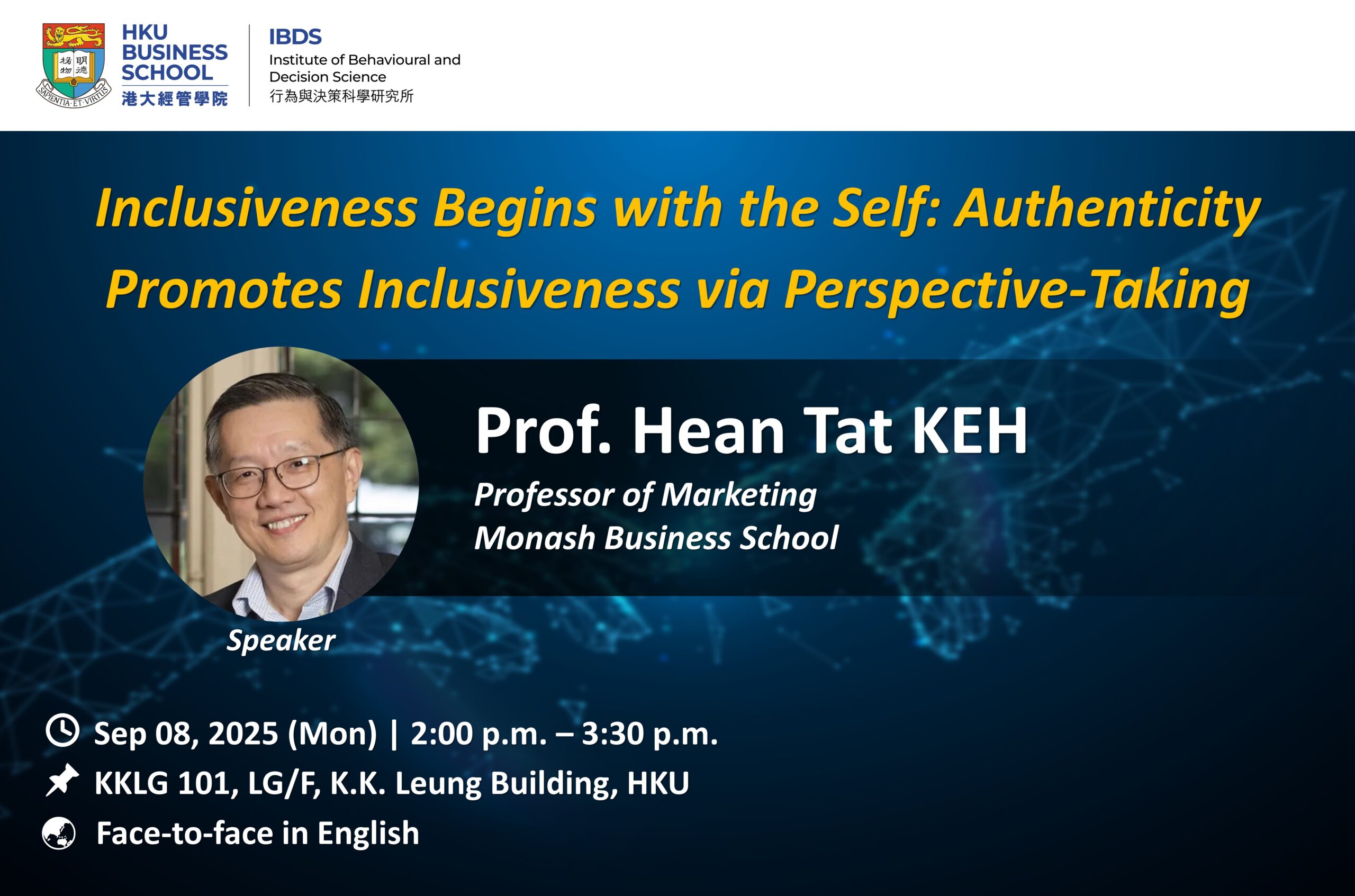
- 8 September 2025 (Monday)
- 2:00 p.m. - 3:30 p.m.
- KKLG 101, LG/F, K.K. Leung Building, HKU
Speaker:
Professor Hean Tat KEH
Professor of Marketing, Monash Business School
Bio:
Hean Tat Keh is Professor of Marketing and former Head of the Department of Marketing at Monash Business School. His current research centers on consumer well-being, with a focus on responsible consumption, healthcare, and services marketing—addressing some of the most pressing challenges in today’s marketplace. His work appears in leading FT50 journals such as Journal of Marketing, Journal of Marketing Research, Journal of Consumer Research, Journal of Consumer Psychology, Journal of the Academy of Marketing Science, and Organizational Behavior and Human Decision Processes. Ranked among the top 1% of marketing scholars globally by ScholarGPS, he is one of only two recipients of both the ANZMAC Distinguished Marketing Researcher and Educator Awards. Until recently, he led a 45-member department across three campuses, ranked among the world’s Top 50 in marketing. Before joining Monash, he held academic roles at the University of Queensland, Peking University, and the National University of Singapore. Professor Keh holds a PhD from the University of Washington, Seattle.
Seminar Abstract:
Prior research on inclusiveness has largely centered on external influences such as diversity policies, leadership directives, and cultural norms. In contrast, we propose that inner authenticity—feeling true to oneself—can also shape one’s openness and inclusiveness toward others. Across five main and eight supplementary studies (five preregistered; total N > 3,000) conducted in both China and the U.S., we show that state authenticity fosters inclusiveness both attitudinally and behaviorally. Our experiments examine individual responses to varying social domains, including non‑traditional life choices (e.g., staying unmarried or child‑free), feminist attire, unconventional hobbies, quiet quitting, immigration, and the controversial “lying flat” (躺平) phenomenon. We show that this effect is explained by perspective-taking, above and beyond the influence of positive affect and self-enhancement motives. Moreover, we rule out inauthenticity as an alternative explanation. Together, these findings establish authenticity as a self-directed, self-transcendent pathway to inclusiveness, advancing theoretical accounts of self-processes in intergroup relations.